Sunday, 2 October 2011

Catch me if you can

Catch Me If You Can is a 2002 American biographical comedy-drama film based on the life of Frank Abagnale Jr 
who, before his 19th birthday, successfully performed cons worth millions of dollars by posing as a Pan American World Airways pilot, a Georgia doctor, and a Louisiana parish prosecutor. His primary crime was check fraud; he became so skillful that the FBI eventually turned to him for help in catching other check forgers. The film is directed by Steven Spielberg and stars Leonardo DiCaprio as Abagnale, Tom Hanks as Hanratty, along with Christopher WalkenAmy AdamsMartin Sheen, and Nathalie Baye.
Development for the film started in 1980 but did not progress until 1997 when the film rights to Abagnale's book were purchased by Spielberg's DreamWorksDavid FincherGore VerbinskiLasse HallströmMiloš Forman and Cameron Crowe had all been possible candidates for director before Spielberg decided to direct. Filming took place from February to May 2002. The film was a financial and critical success, and the real Abagnale reacted positively to it.
Cast:
  • Leonardo DiCaprio as Frank Abagnale, Jr. Before his 19th birthday, Frank successfully conned millions of dollars worth of checks as a Pan Am pilot, doctor, and Louisiana parish prosecutor.
  • Tom Hanks as Carl Hanratty, an FBI agent who pursues Frank for most of the film. Hanratty is often mocked by other agents who do not take check fraud seriously. Hanratty is divorced, and his daughter and wife live in Chicago. In the end, Carl and Frank become great friends.
  • Christopher Walken as Frank Abagnale, Sr., Frank's father, and a World War II veteran. Frank, Sr. loses his wife Paula and most of his wealth after he committed tax evasion. Frank, Sr. dies after falling down a staircase in a train station.
  • Nathalie Baye as Paula Abagnale. Frank, Sr. meets her when she is 18 years old in Montrichard, France during World War II. Six weeks later the couple marries. They divorce when Frank is 16, leaving Paula to marry Jack Barnes. Towards the end of the film, they have a daughter.
  • Amy Adams as Brenda Strong. Before becoming a nurse, Brenda has an abortion. Her strict Lutheran parents disown her, until they meet Frank, Jr.
  • Martin Sheen as Roger Strong, Brenda's father, and Carol's husband. Roger is a well-recognized district attorney in Louisiana and is not easily convinced that Frank, Jr. graduated from law school.
  • James Brolin as Jack Barnes, an associate of Frank, Sr. at the New Rochelle, New York Rotary Club. Barnes later carries on an affair with Paula, leading to the divorce of Frank Jr.'s parents.
  • Nancy Lenehan as Carol Strong, Brenda's mother and Roger's wife. When thinking that Frank, Jr. is a doctor, lawyer and Lutheran, she is highly ecstatic for her daughter's marriage.

Frank Abagnale sold the film rights to his autobiography in 1980. Producer Michel Shane purchased the film rights in 1990, for Paramount Pictures. By December 1997, Barry Kemp purchased the film rights from Shane, bringing the project to DreamWorks, with Jeff Nathanson writing the script. By April 2000, David Fincher was attached to direct over the course of a few months, but dropped out in favor of Panic Room. In July 2000, Leonardo DiCaprio had entered discussions to star, with Gore Verbinski to direct.  Steven Spielbergsigned on as producer, and filming was set to begin in March 2001.
musical adaptation of the same name premiered at the 5th Avenue Theatre in SeattleWashington in July 2009. It began previews on Broadway at the Neil Simon Theatre on March 11, 2011 and officially opened April 10, 2011. The musical has been nominated for four Tony Awards, including Best Musical.


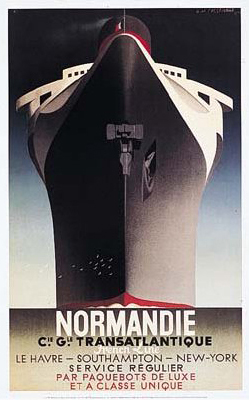
Cassandre

Adolphe Mouron Cassandre was born in Ukraine in 1901 to French parents. He was best known as a painter, a commercial poster artist, and a typeface designer. 
He studied at the Académie de Beaux-Arts in Paris and also at the Académie Julian. The fact that posters were extremely popular at the time, meant that he was able to work for a printing house. He was greatly inspired by surrealism and cubism. Cassandre gained his reputation by winning first prize at the Exposition des Arts Décoratifs et Industriels in 1925, when he submitted his poster 'Le Bûcheron' (The Woodcutter). As he became more successful, he was able to partner up with some friends who helped him create a design agency called Alliance Graphique, which saw its success throughout the 1930's. His posters are famous for their innovative graphic style and references to other painters such as, Picasso and Ernst.
He was also a lecturer at the École des Arts Décoratifs in Paris. 


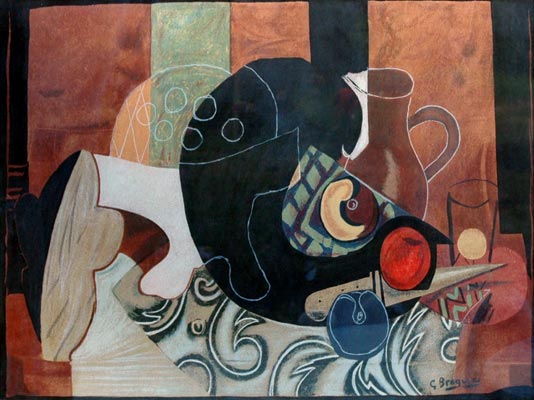
Georges Braque

Georges Braque was a Frenchman born in 1882, along with his best friend and fellow artist, Pablo Picasso, he was one of the founders of the artistic style, Cubism. 
As he was growing up in the town of Le Havre, he learned the trade of his father, which was decorating and painting houses. However, he also took evening classes at the local 'École des Beaux-Arts'. His work was initially very similar to that of his Impressionist predecessors, but after viewing some of the work of the Fauvists (Matisse, Derain, etc...), he was thoroughly converted to this style, adopting bright colours to represent the emotions inside of him. He worked in close contact with Raoul Dufy and Othon Friesz, who were from the same town as him, this entourage led him to produce a more subdued response to Fauvism. After going to Paris with Friesz and seeing the work of Cézanne and the Parisian Avant-gardism, his work evolved enormously and the joining together of all these styles resulted in a style resembling Cubism. At the beginning of the 19th century, Braque met Picasso and the two became friends and started working together. Whilst Picasso was interested in translating a tribal influence into his work, Braque focused more on the idea of introducing multiple perspectives into his pictures, this was an idea from Cézanne. It is the joint effort of Braque and Picasso, that we now consider to be Cubism. This name refers to the geometry of their painting style. Braque died in 1963 and is now viewed as one of the pioneers of modern art.


John Baskerville

John Baskerville was born in Worcestershire in 1706. He was a businessman who learnt printing and typography. He became a member of the Royal Arts Society and an associate of various members of the Lunar Society. Today, Baskerville is renowned for the typefaces he created, thanks to revivals of his work, the typefaces have been transformed into digital form, giving us fonts such as: Baskerville, and Mrs Eaves (After his wife, Sarah Eaves). John was also responsible for many innovations in the world of printing, but also in ink and paper production. Being a renaissance Humanist, he was highly atheistic, but this did not prevent him from printing the first ever Folio Bible in 1763. He also printed many documents for the University of Cambridge, which have still been conserved today. At his request, when he died, Baskerville's body was buried in the unconsecrated garden of his house, Easy Hill. Later, his body was moved because the land was needed to construct a canal, the corpse was stored in a warehouse for sometime before being secretly moved to the crypt at Christ Church, Birmingham. This Church was demolished in 1899, so the body was moved once again, but this time back to Easy Hill, where a cemetery had been built in his memory.

Marian Bantjes

Marian Bantjes is a Canadian typographer, artist, writer and designer born in 1963. 
She began working in visual communication in 1983 as a typesetter for books. In the early 90's she started to become well known as a graphic designer and from the start of the 21st century to today, she is world-famous for her work, having been published several times in the French design magazine, étapes, the Brazilian magazine, Tupografia, Eye Magazine, Creative Review and Fontoshop's Font 004. Her clients include, Stagmeister, Pentagram, The Guardian, The New York Times and Bruce Mau Design. The graphic designer, Stefan Stagmeister even said that he believed Bantjes to be one of the most innovative graphic artists of our time. Her style is extremely ornamental and she claims to illustrate the spiritual side of words through the way she represents them. Marian's work is very personal and some think that she has broken the mould a bit by submitting such personal work to magazines and competitions. She, however, believes that she is just sharing her personal relationship with type with the world and thinks of it as her duty.


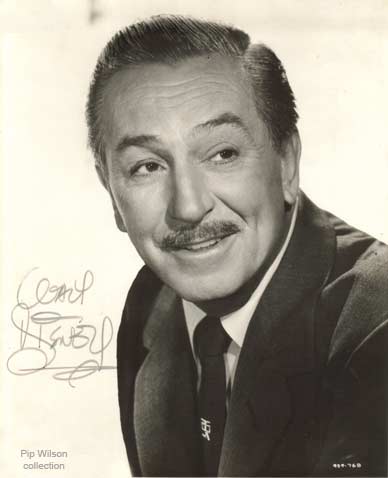
Walt Disney

Walter Elias Disney was born in Chicago (USA) in 1901 of an Irish-Canadian father and a German-American mother. He was a film-producer, director, screenwriter, voice actor, entrepreneur, animator, entertainer and international icon. With his brother, Roy O. Disney, he was the co-founder of the Walt Disney Company which has to date received 59 Academy Award nominations and 22 Oscars. This is currently the World record.
Walt was of French descent, his family name originally being: D'Isigny, it was later anglicised to Disney. His ancestor Robert D'Isigny came over to England with William the Conquerer in 1066 and the family later moved to Ireland and then Disney's great-grandfather Arundel Disney emigrated to the USA during the potato famine.

During his childhood, Walt developed his drawing skills and then when he attended high school, he began taking night-classes at the Chicago Art Institute. He quickly became the official school cartoonist, illustrating for the school newspaper, but he dropped out of school at 16, with the intention of joining the army, from which he was rejected for being underage.
He then decided to enrol in the Red Cross and served as an ambulance driver in France before returning to the USA to become a newspaper artist. Disney was unsuccessful in this job and so his brother, Roy got him some work in an art studio, after creating advertisements for newspapers, theatres and cinemas there, he read a book on animation and decided to pursue a career in this area which he considered to present great potential. Walt then opened his own business and produced short animation clips called, Laugh-O-Grams. The company gained more and more debt and eventually Walt partnered up with his brother and they moved the studio to Hollywood and created a series of short animation sequences based on stories from Alice in Wonderland.
This enabled him to create various characters and animate them in ways that brought each one, its own personality. After losing the rights to his successful character, Oswald, Disney decided that he needed a new one to replace him, one that would be so famous, it would become the mascot of Disney himself. He chose to base the character on a pet mouse that he had adopted during his time working on the Laugh-O-Grams. Thus Mickey Mouse was born. The mouse may have been Disney's pet animal, but Mickey was undoubtedly his pet character. Until 1947, it was Walt himself who provided Mickey's voice and personality. The visual appearance of the character was modified by the artist, Ub Lwerks to make him easier to animate, but Disney definitely provided him with his inner appearance. Mickey Mouse appeared in various short animation sequences, but his first real success was as Steamboat Willie, this was Disney's first cartoon that actually used sound, but after this, all of his cartoons did.
After a fairly unsuccessful try at something called Silly Symphonies, Walt decided to make a feature-length film. His family and co-producers thought this idea to be pure madness and did everything they could to talk Disney out of the idea of animating the popular fairytale of Snow White. They were, however, unable to convince Walt that his plan was a bad idea, and he went ahead and did it. When the finished film was finally released in 1938, it quickly became the most successful motion-picture to date, winning a total of seven Oscars. This was the beginning of what was considered to be the Golden Age of Animation for Disney Studios. Walt then began projects to animate all of the popular fairytales as well as creating a host of characters to befriend Mickey Mouse, such as: Minnie Mouse, Donald Duck, Daisy Duck, Goofy and Pluto. During WWII, the only animation film that was produced was Dumbo, but after the States entered the war, they requisitioned Disney Studios to produce propaganda and motivational films designed to encourage both the soldiers and their friends and families. As soon as the war had ended, Disney immediately began creating his cartoons once again, but this time they were not just aimed at children, he also started making films with real people in them. His animation shorts, however, began to lose their notoriety with new studios like Warner Brothers taking the lead with Bugs Bunny, Daffy Duck and company.
During the last 10 years of his life, Disney began realising a vision he had been imagining for quite some time, he had been imagining a real-life world for his characters to dwell in, a place where children and adults could come and meet with them and experience for themselves the fantasy worlds that he had been creating through animation. Walt created Disneyland, an amusement park where people of all ages could come to enjoy themselves. Thus began a whole new realm to the wonderful world of Disney... Unfortunately he would not ever live to see it at its most successful as he died of lung cancer in 1966.

Monday, 26 September 2011

Peter Sellers

Richard Henry Sellers (known as Peter Sellers) was an English actor born in 1925. His most famous role was as inspector Clouseau in The Pink Panther film series, but also played in films such as, Dr. Strangelove and Lolita. He participated in the BBC radio comedy series, The Goons Show for a good number of years. This is what enabled his rise to fame, thanks to his ability to speak in many different accents and talk in different voices. Despite his award winning career, Sellers was a substance abuser, emotionally unstable and claimed to have no identity outside of the characters he played. He was married a total of four times and had three children, one of which is dead.
It is thought that despite his obvious talent for acting and directing, Sellers was unable to cope with the strain and pressure of fame, this is what many people think, pushed him to an early grave, making him die of a heart-attack at the age of 54.

In his early life, Peter attended Catholic school and was apparently fascinated by the Catholic religion, but after a few years in the school, he 'discovered' that he was in fact, a Jew. This made his years at Catholic school particularly difficult, as well as his integration into the world of show-business where, at the time, Jews were not really tolerated as comedians, actors and directors, the smaller and less significant roles. This did not, however, discourage Sellers from pursuing what he believed to be his calling: to entertain.
After serving as an airman during WWII, he returned to England in 1948 and began performing stand-up routines in various theatres. His first audition for a major role in radio resulted from him telephoning the BBC radio producer, Roy Speer and impersonating Kenneth Horne, a radio star so that the producer would agree to talk to him. Speer labelled him as a 'cheeky young sod' for this daring act, but it got him the audition!

The Goons Show constituted Peter Sellers, Harry Secombe and Spike Milligan. The shows used words to create 'slapstick' comedy. The humour was often based on bizarre and unlikely concepts such as the idea of an assailant who manages to keep a grand piano concealed on his person, striking the unsuspecting 'Eckles' on the head on numerous occasions. Each of the 'Goons' takes on several recurring characters who all have different voices and their own particular (and whacky) personalities.
The series The Pink Panther gained a cult following and a cartoon series of the same name was equally developed, the story-line, however, is very different to that of the film series. Peter Sellers actually died in the middle of the filming of the last Pink Panther film ever made. He had been the victim of several heart-attacks throughout his later life, but refusing to take the route of conventional medicine, which could have saved his life, he sought out psychic healers instead. The film crew decided to continue with the making of the final Pink Panther film without Sellers, in his memory, although the outcome was somewhat dull and uninspiring compared to the action and comedy packed prequels. It is possible to feel the sadness of the actors as they continue to act without Peter, and this obviously had an effect on the quality of their performance.

Marilyn Monroe

Marilyn Monroe was born Norma Jeane Mortenson in LA in 1926. Her mother was mentally unable to cope with raising Norma, so she spent much of her childhood in foster homes. One day, when Norma was 7, her mother stormed into the foster home and attempted to kidnap the child in a duffel bag. Her mother was then admitted into a mental institute and Norma was put into the care of her best friend, Grace McKee. It was Grace who put the ideas about acting into her head and encouraged her to pursue this career. When Norma was 9, Grace got married and sent the girl into an orphanage. 
She spent several years going from foster home to 
foster home, before finally going back to live with Grace and her family. However, the Norma was the victim of sexual abuse from her foster father and so she was sent to live with one of Grace's aunts in Compton, but even there, she suffered sexual abuse from one of the aunt's sons. She then went to live with another of Grace's aunts and this was, as she later described the most stable period in her live, where she truly felt secure, but unfortunately it was short-lead as the old lady had many health issues and became unable to care for her. So Norma moved back in with Grace and her husband and met James (Jim) Dougherty at middle school, whom she began a relationship with. When Grace and her family wanted to move away, to prevent Norma from going back into care, she pressured her boyfriend into marrying her, even though she was only sixteen. Dougherty was away a lot in the Merchant Marine, and during his absence, Norma worked in the local factory. It was in this factory that she was first noticed for her beauty. 
A photographer encouraged her to apply for a modelling agency and she was accepted. So began her successful modelling career, which then led her to get noticed by the Fox producer, Ben Lyon who then employed her as an actress, performing minor roles in films. It was his idea that she change her name to Marilyn, after Marilyn Miller, she chose the name Monroe, as it was her mother's maiden name. Little by little, Monroe gained more notoriety and the importance of her roles increased until she truly was an international movie star. Her breakthrough was a starring role in the 1949 film, Love Happy, this brought her to the attention of the talent agent, Johnny Hyde. From this point on, she was fully successful in her work. Her love life was very unstable, she was married 3 times and had numerous affairs, her most famous being with President John F Kennedy. It is thought that her traumatic childhood had a huge effect on her romantic life, resulting in excessive sexual activity and emotional insecurity. Like her mother, Monroe was psychologically unstable and suffered from chronic depression throughout her life.
Monroe's last film was entitled The Misfits. During this time, Marilyn suffered from insomnia and alcoholism and was frequently rushed to hospital after collapsing on film sets. On the 5th of August 1962, she was found dead in her home in LA, the cause being 'acute barbiturate poisoning'. It is unknown how exactly she managed to ingest such large quantities of sleeping pills. The main theory is that she committed suicide, however there are many conspiracy theories involving people like John and Robert Kennedy.

Tuesday, 6 September 2011

Dr. Strangelove

Dr. Strangelove is a 1964 black comedy film that was written to give a satyrical view of the nuclear scare. It was co-written, directed and produced by Stanley Kubrick and starred actors such as: Peter Sellers and George C. Scott. The story is about a crazy American Air Force officer who orders a nuclear attack on the USSR, and then various Western heads of State attempt to recall the bombers in order to prevent a potential nuclear apocalypse. In 1989, the film was called 'culturally significant' by the United States Library of congress and was selected for preservation by the National Film Registry. In this film, the four main characters are all played by Peter Sellers, this in fact, was the condition that was set by Columbia Pictures in order to finance the film's production.
The film is vaguely based on Peter George's novel: Red Alert, although the character, Dr Strangelove, does not actually feature in the original novel. The film won various BAFTA and Academy Awards including: Best actor, best British art direction and best film from any source.


David Byrne

David Byrne was born in Scotland in 1952 and was most famous for being the principal songwriter of the New Wave band: The Talking Heads. He has also released several solo albums and has won a Grammy, a Golden Globe Award and an Oscar for his work in film, opera, photography and non-fiction writing. He now lives and works in New York, but remains a British citizen. He has composed music for ballets such as The Catherine Wheel which appeared on Broadway and In Spite of Wishing and Waiting which was for a Belgian dance company. On top of that, he is a film-soundtrack composer and has written for films such as: Young Adam and Something Wild. He even wrote, directed and starred in the musical True Stories. Byrne has also worked with charities, contributing songs to five AIDS benefit album compilations.  


Le Corbusier

Le Corbusier (Charles-Édouard Jeanneret) was born in Switzerland in 1887. He later became a French citizen and was famous for being an architect, designer, urbanist, writer and painter. He designed buildings of the Modernist style that were constructed throughout the world. The main points that he adopted in his architectural designs were: the idea of supporting pilotis (Concrete or metal stilts that reinforced the structure of the building. This enabled the walls to be non-supporting which made them more flexible as far as their design goes, meaning that the façade could be almost any shape the architect desired, or even contain huge windows without being a safety hazard. With these three points, he also used open floor-plans which made the rooms versatile and meant that their purposes could be changed. The final point that he utilised was the concept of roof-gardens to compensate for the green areas lost in the construction of the buildings. These are all points that are still used today in contemporary architectural design. His most famous building is probably the Villa Savoye. 


Marion Deuchars

Marion Deuchars is an illustrator living and working in Britain. She studied illustration and print-making at Duncan of Jordanstone in Dundee and then at the Royal College of Art in London.
Deuchars has worked in illustration, publishing, editorial, packaging, interior design, brand development, web design, corporate literature and brand development. Her work generally includes a substantial amount of handwriting an line drawings but she also creates collages and uses photography as a basis for quite a lot of her work. She has recently written, illustrated and published a book called “Let's Make Some Great Art” in which she gives ideas of pictures and paintings to her readers and encourages them to make their own versions.


Michael Graves

Michael Graves was born in 1934 and is an American architect who participated in a famous architectural exhibition in 1972, gaining him a status as one of 'The New York Five' along with Peter Eisenman, Charles Gwathmey, John Hejduk and Richard Meier. He is a pioneer of architectural modernism and is greatly inspired by the work of Le Corbusier. His work did receive a lot of harsh critique, notably by a group of essayists who called themselves 'the greys' and claimed to be attacking the modernist architects whom they called 'the whites'. They refused the aesthetic of the modernist style and said that it created buildings that only provoked feelings of 'indifference' amongst their onlookers. Graves did, however remain faithful to the Corsbusian style and even today he stays active in his work, despite being paralysed from the waist down after contracting Meningitis.  


Amy Bloom

Amy Bloom is an author who was born in the USA in 1953. Bloom initially studied to be a social worker and practiced psychotherapy for a number of years. She is now the writer in residence at Wesleyan University and has also been a lecturer of creative writing at Yale University. Amy regularly writes features for newspapers such as: The New Yorker, The New York Times Magazine and Vogue. Her novels had been nominated for The National Book Award and The National Book Critics Award. She is also head-writer and producer of a television series called: State of Mind which appears on the Lifetime Television Network.


Fernand Léger

Fernand Léger was born in 1881 and was a French painter, sculptor and film-maker. He lived in a time where the industrial revolution had completely overrun society and machines were becoming increasingly indispensable to the lives of factory workers, and even in the home. Unlike many of the artists of his time, Léger did not revolt against the industrial world surrounding him, but embraced it and portrayed it in a positive light in his paintings. He would seek to illustrate a friendship between man and machine by showing the two working together. His work is very colourful and is said to be a predecessor of Pop-Art.


Jackson Pollock

Jackson Pollock was born in 1912. He studied art in New York and after suffering with alcoholism for some years, he underwent psychotherapy based on the ideas of Carl Jung. He was encouraged to use his art as a way of expressing his feelings and thoughts and many of the Jungian principles he acquired are visible in his paintings. Pollock's particular style of painting, called “dripping”, or “all-over” consisted of splattering paint on very large canvases in a seemingly random way. This technique is quite typical of the abstract expressionist movement to which Pollock belonged. It is thought that this technique brought about the concept of “action-painting”. A film was made about him in 2000 featuring actors like Ed Harris, Marcia Gay Harden and Jennifer Connelly.


Patricia Neal

Patricia Neal was an actress born in Tennessee in 1926. She starred in many Broadway movies such as: The voice of the Turtle, Another Part of the Forest and The Fountainhead. She won several Academy and BAFTA awards during her career. The actress was married to English writer Roald Dahl for 30 years. And they had 5 children together. She worked with actors such as: Ronald Reagan, John Wayne and Andy Griffith. In 1978, a rehabilitation centre was dedicated to her for her support for victims of paralysis. She died in 2010 from lung cancer.


All the President's Men

All the President's Men is a political thriller based on a non-fiction novel that was written by Bob Woodward and Carl Bernstein, who were journalists and are the main characters of the film.
It is about the scandal of the Watergate affair when President Nixon was in power. These two journalists worked to uncover the secrets that the government was holding back and eventually ended up writing a book about the affair. This 1976 film won the Academy Awards, various other awards and was nominated for awards such as the BAFTA Film and Golden Globe Awards.  


George Harrison

Former lead guitarist of The Beatles, George Harrison was also known as a songwriter, actor and film and record producer. He was often called 'the quiet Beatle' and he introduced the other members of the band to Indian mysticism which soon became an obvious influence in their songwriting and musical style; he was an advocate of the Hare Krishna movement.
His career as a solo artist, after the breakup of the Beatles became increasingly angled towards a style that combined the sounds of traditional Indian music and a more electronic/Western atmosphere. He played in lots of different artists' songs during this time and became fully engaged in promoting Indian chanting in the Western world. He died in 2001 at the age of 58.


Einstein on the Beach

Einstein on the Beach is an opera that was written by Phillip Glass in 1976. It is unlike any other opera of its time as it has no storyline, no hero and no obvious link between different scenes, or even between what is seen and heard. It is said to have irreparably changed the image of opera.
Glass had some difficulty in defining the nature of Einstein on the Beach, originally as it did not seem to fall comfortably into the niche of a dance, or a musical, or a painting. So Glass chose to call it an opera, coming from the Latin, opus, meaning work. In that way, it is the perfect word to describe this unconventional spectacle. The opera plays with using different speeds and moods, created by the sounds of the music, the dancers and singers and by the occasional bit of spoken text.


David Carson

David Carson is a world-famous American graphic designer. He is best known for his experimental typography (associated with the 'grunge' typography era) and his innovative magazine design.
Some say that he was the most influential graphic designer of the 1990's.
Carson actually studied sociology, but was exposed to graphic design as a part of his course. After attending a workshop, he started to experiment with his own style of graphics and soon became famous for this inventive style, which mainly consists of distorting typefaces to create 'fractured imagery'. He has worked for many important clients over the years such as: Nike, Levis, British Airways, Microsoft and Pepsi. 


Sonia Gandhi

Sonia Gandhi is an Italian born Indian politician, who is the widow of former Indian Prime-minister, Rajiv Gandhi. She decided to stay away from politics after the assassination of her husband in 1991, despite all of the efforts of her late husbands colleagues to persuade her to do otherwise. Finally in 1997, she caved in and a year later, she had been elected as President of the National Congress Party, she is the longest serving president in the history of the party, and the fifth foreign-born president of the party. This has been subject to much controversy over the course of her career, but despite this, she has been named the third most powerful woman in the world and the ninth most powerful person.