Sunday, 2 October 2011

Catch me if you can

Catch Me If You Can is a 2002 American biographical comedy-drama film based on the life of Frank Abagnale Jr 
who, before his 19th birthday, successfully performed cons worth millions of dollars by posing as a Pan American World Airways pilot, a Georgia doctor, and a Louisiana parish prosecutor. His primary crime was check fraud; he became so skillful that the FBI eventually turned to him for help in catching other check forgers. The film is directed by Steven Spielberg and stars Leonardo DiCaprio as Abagnale, Tom Hanks as Hanratty, along with Christopher WalkenAmy AdamsMartin Sheen, and Nathalie Baye.
Development for the film started in 1980 but did not progress until 1997 when the film rights to Abagnale's book were purchased by Spielberg's DreamWorksDavid FincherGore VerbinskiLasse HallströmMiloš Forman and Cameron Crowe had all been possible candidates for director before Spielberg decided to direct. Filming took place from February to May 2002. The film was a financial and critical success, and the real Abagnale reacted positively to it.
Cast:
  • Leonardo DiCaprio as Frank Abagnale, Jr. Before his 19th birthday, Frank successfully conned millions of dollars worth of checks as a Pan Am pilot, doctor, and Louisiana parish prosecutor.
  • Tom Hanks as Carl Hanratty, an FBI agent who pursues Frank for most of the film. Hanratty is often mocked by other agents who do not take check fraud seriously. Hanratty is divorced, and his daughter and wife live in Chicago. In the end, Carl and Frank become great friends.
  • Christopher Walken as Frank Abagnale, Sr., Frank's father, and a World War II veteran. Frank, Sr. loses his wife Paula and most of his wealth after he committed tax evasion. Frank, Sr. dies after falling down a staircase in a train station.
  • Nathalie Baye as Paula Abagnale. Frank, Sr. meets her when she is 18 years old in Montrichard, France during World War II. Six weeks later the couple marries. They divorce when Frank is 16, leaving Paula to marry Jack Barnes. Towards the end of the film, they have a daughter.
  • Amy Adams as Brenda Strong. Before becoming a nurse, Brenda has an abortion. Her strict Lutheran parents disown her, until they meet Frank, Jr.
  • Martin Sheen as Roger Strong, Brenda's father, and Carol's husband. Roger is a well-recognized district attorney in Louisiana and is not easily convinced that Frank, Jr. graduated from law school.
  • James Brolin as Jack Barnes, an associate of Frank, Sr. at the New Rochelle, New York Rotary Club. Barnes later carries on an affair with Paula, leading to the divorce of Frank Jr.'s parents.
  • Nancy Lenehan as Carol Strong, Brenda's mother and Roger's wife. When thinking that Frank, Jr. is a doctor, lawyer and Lutheran, she is highly ecstatic for her daughter's marriage.

Frank Abagnale sold the film rights to his autobiography in 1980. Producer Michel Shane purchased the film rights in 1990, for Paramount Pictures. By December 1997, Barry Kemp purchased the film rights from Shane, bringing the project to DreamWorks, with Jeff Nathanson writing the script. By April 2000, David Fincher was attached to direct over the course of a few months, but dropped out in favor of Panic Room. In July 2000, Leonardo DiCaprio had entered discussions to star, with Gore Verbinski to direct.  Steven Spielbergsigned on as producer, and filming was set to begin in March 2001.
musical adaptation of the same name premiered at the 5th Avenue Theatre in SeattleWashington in July 2009. It began previews on Broadway at the Neil Simon Theatre on March 11, 2011 and officially opened April 10, 2011. The musical has been nominated for four Tony Awards, including Best Musical.


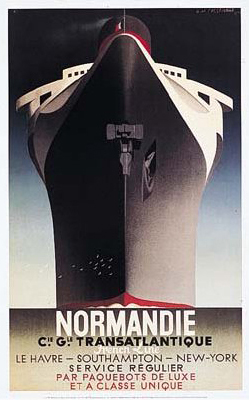
Cassandre

Adolphe Mouron Cassandre was born in Ukraine in 1901 to French parents. He was best known as a painter, a commercial poster artist, and a typeface designer. 
He studied at the Académie de Beaux-Arts in Paris and also at the Académie Julian. The fact that posters were extremely popular at the time, meant that he was able to work for a printing house. He was greatly inspired by surrealism and cubism. Cassandre gained his reputation by winning first prize at the Exposition des Arts Décoratifs et Industriels in 1925, when he submitted his poster 'Le Bûcheron' (The Woodcutter). As he became more successful, he was able to partner up with some friends who helped him create a design agency called Alliance Graphique, which saw its success throughout the 1930's. His posters are famous for their innovative graphic style and references to other painters such as, Picasso and Ernst.
He was also a lecturer at the École des Arts Décoratifs in Paris. 


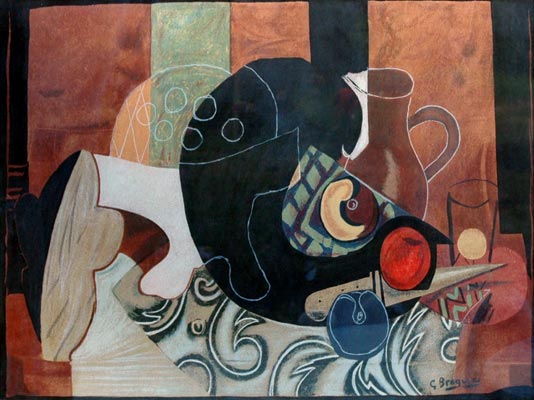
Georges Braque

Georges Braque was a Frenchman born in 1882, along with his best friend and fellow artist, Pablo Picasso, he was one of the founders of the artistic style, Cubism. 
As he was growing up in the town of Le Havre, he learned the trade of his father, which was decorating and painting houses. However, he also took evening classes at the local 'École des Beaux-Arts'. His work was initially very similar to that of his Impressionist predecessors, but after viewing some of the work of the Fauvists (Matisse, Derain, etc...), he was thoroughly converted to this style, adopting bright colours to represent the emotions inside of him. He worked in close contact with Raoul Dufy and Othon Friesz, who were from the same town as him, this entourage led him to produce a more subdued response to Fauvism. After going to Paris with Friesz and seeing the work of Cézanne and the Parisian Avant-gardism, his work evolved enormously and the joining together of all these styles resulted in a style resembling Cubism. At the beginning of the 19th century, Braque met Picasso and the two became friends and started working together. Whilst Picasso was interested in translating a tribal influence into his work, Braque focused more on the idea of introducing multiple perspectives into his pictures, this was an idea from Cézanne. It is the joint effort of Braque and Picasso, that we now consider to be Cubism. This name refers to the geometry of their painting style. Braque died in 1963 and is now viewed as one of the pioneers of modern art.


John Baskerville

John Baskerville was born in Worcestershire in 1706. He was a businessman who learnt printing and typography. He became a member of the Royal Arts Society and an associate of various members of the Lunar Society. Today, Baskerville is renowned for the typefaces he created, thanks to revivals of his work, the typefaces have been transformed into digital form, giving us fonts such as: Baskerville, and Mrs Eaves (After his wife, Sarah Eaves). John was also responsible for many innovations in the world of printing, but also in ink and paper production. Being a renaissance Humanist, he was highly atheistic, but this did not prevent him from printing the first ever Folio Bible in 1763. He also printed many documents for the University of Cambridge, which have still been conserved today. At his request, when he died, Baskerville's body was buried in the unconsecrated garden of his house, Easy Hill. Later, his body was moved because the land was needed to construct a canal, the corpse was stored in a warehouse for sometime before being secretly moved to the crypt at Christ Church, Birmingham. This Church was demolished in 1899, so the body was moved once again, but this time back to Easy Hill, where a cemetery had been built in his memory.

Marian Bantjes

Marian Bantjes is a Canadian typographer, artist, writer and designer born in 1963. 
She began working in visual communication in 1983 as a typesetter for books. In the early 90's she started to become well known as a graphic designer and from the start of the 21st century to today, she is world-famous for her work, having been published several times in the French design magazine, étapes, the Brazilian magazine, Tupografia, Eye Magazine, Creative Review and Fontoshop's Font 004. Her clients include, Stagmeister, Pentagram, The Guardian, The New York Times and Bruce Mau Design. The graphic designer, Stefan Stagmeister even said that he believed Bantjes to be one of the most innovative graphic artists of our time. Her style is extremely ornamental and she claims to illustrate the spiritual side of words through the way she represents them. Marian's work is very personal and some think that she has broken the mould a bit by submitting such personal work to magazines and competitions. She, however, believes that she is just sharing her personal relationship with type with the world and thinks of it as her duty.


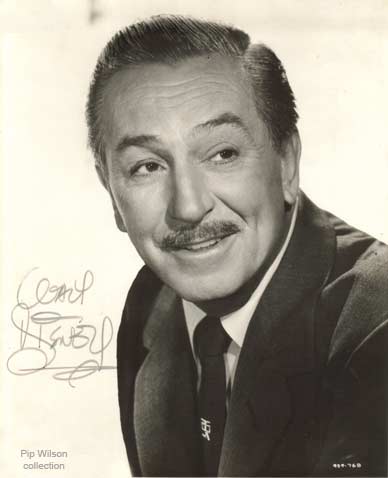
Walt Disney

Walter Elias Disney was born in Chicago (USA) in 1901 of an Irish-Canadian father and a German-American mother. He was a film-producer, director, screenwriter, voice actor, entrepreneur, animator, entertainer and international icon. With his brother, Roy O. Disney, he was the co-founder of the Walt Disney Company which has to date received 59 Academy Award nominations and 22 Oscars. This is currently the World record.
Walt was of French descent, his family name originally being: D'Isigny, it was later anglicised to Disney. His ancestor Robert D'Isigny came over to England with William the Conquerer in 1066 and the family later moved to Ireland and then Disney's great-grandfather Arundel Disney emigrated to the USA during the potato famine.

During his childhood, Walt developed his drawing skills and then when he attended high school, he began taking night-classes at the Chicago Art Institute. He quickly became the official school cartoonist, illustrating for the school newspaper, but he dropped out of school at 16, with the intention of joining the army, from which he was rejected for being underage.
He then decided to enrol in the Red Cross and served as an ambulance driver in France before returning to the USA to become a newspaper artist. Disney was unsuccessful in this job and so his brother, Roy got him some work in an art studio, after creating advertisements for newspapers, theatres and cinemas there, he read a book on animation and decided to pursue a career in this area which he considered to present great potential. Walt then opened his own business and produced short animation clips called, Laugh-O-Grams. The company gained more and more debt and eventually Walt partnered up with his brother and they moved the studio to Hollywood and created a series of short animation sequences based on stories from Alice in Wonderland.
This enabled him to create various characters and animate them in ways that brought each one, its own personality. After losing the rights to his successful character, Oswald, Disney decided that he needed a new one to replace him, one that would be so famous, it would become the mascot of Disney himself. He chose to base the character on a pet mouse that he had adopted during his time working on the Laugh-O-Grams. Thus Mickey Mouse was born. The mouse may have been Disney's pet animal, but Mickey was undoubtedly his pet character. Until 1947, it was Walt himself who provided Mickey's voice and personality. The visual appearance of the character was modified by the artist, Ub Lwerks to make him easier to animate, but Disney definitely provided him with his inner appearance. Mickey Mouse appeared in various short animation sequences, but his first real success was as Steamboat Willie, this was Disney's first cartoon that actually used sound, but after this, all of his cartoons did.
After a fairly unsuccessful try at something called Silly Symphonies, Walt decided to make a feature-length film. His family and co-producers thought this idea to be pure madness and did everything they could to talk Disney out of the idea of animating the popular fairytale of Snow White. They were, however, unable to convince Walt that his plan was a bad idea, and he went ahead and did it. When the finished film was finally released in 1938, it quickly became the most successful motion-picture to date, winning a total of seven Oscars. This was the beginning of what was considered to be the Golden Age of Animation for Disney Studios. Walt then began projects to animate all of the popular fairytales as well as creating a host of characters to befriend Mickey Mouse, such as: Minnie Mouse, Donald Duck, Daisy Duck, Goofy and Pluto. During WWII, the only animation film that was produced was Dumbo, but after the States entered the war, they requisitioned Disney Studios to produce propaganda and motivational films designed to encourage both the soldiers and their friends and families. As soon as the war had ended, Disney immediately began creating his cartoons once again, but this time they were not just aimed at children, he also started making films with real people in them. His animation shorts, however, began to lose their notoriety with new studios like Warner Brothers taking the lead with Bugs Bunny, Daffy Duck and company.
During the last 10 years of his life, Disney began realising a vision he had been imagining for quite some time, he had been imagining a real-life world for his characters to dwell in, a place where children and adults could come and meet with them and experience for themselves the fantasy worlds that he had been creating through animation. Walt created Disneyland, an amusement park where people of all ages could come to enjoy themselves. Thus began a whole new realm to the wonderful world of Disney... Unfortunately he would not ever live to see it at its most successful as he died of lung cancer in 1966.